

The unique Luddites have been textile staff making an attempt to cease machines from taking their jobs.
At present, the time period describes individuals who can’t or received’t undertake new know-how.
Increase your hand, Division of Properties and Neighborhood Renewal!
How else to clarify this state company’s insistence on completely bonkers paperwork necessities for substantial rehabilitation purposes?
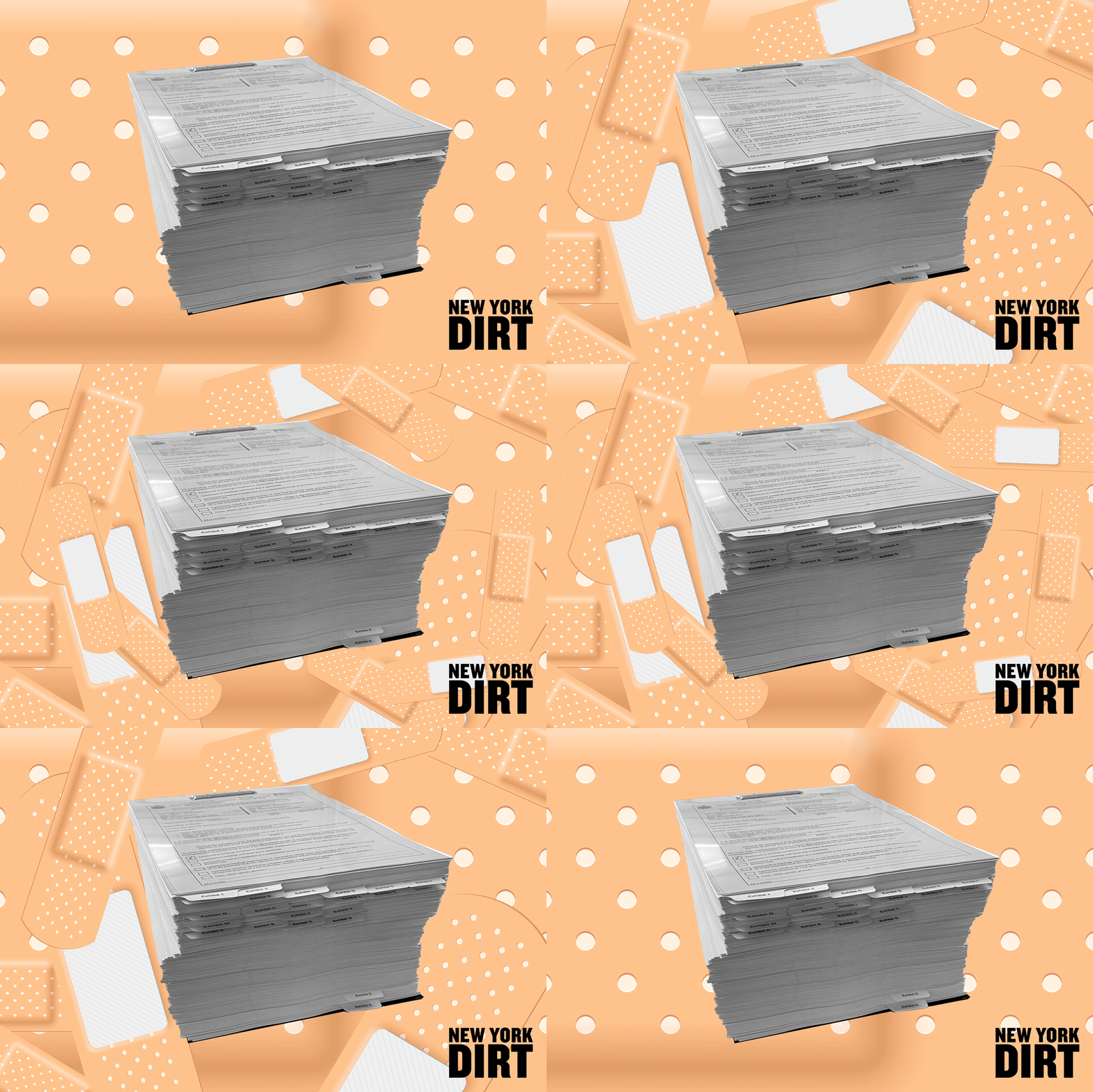
The photograph above is an precise sub-rehab utility. It’s 1,100 pages. And that’s not even the worst half.
One in every of these stacks should be printed for every tenant within the constructing to be rehabbed. On this case, the printing invoice got here to $4,900.
Delivery isn’t included; HCR has no Prime membership possibility, and sadly, hand supply to tenants isn’t allowed. Candidates should ship the printouts — labeled for every tenant — to HCR, which in flip ships them to the tenants. Tenants are entitled to overview and reply to all claims made within the application, which itself is 2 pages, however requires supporting documentation for the claims.
“The DHCR wouldn’t enable us to maintain one copy on-line or present it to the tenants on-line,” stated an individual who helped put together the paperwork. “That is our authorities at work.”
However is that this as a result of the company is staffed by luddites? I believe not.
Paperwork necessities have been decreased by each stage of presidency — a significant enchancment, even when the digital alternate options depend on clunky web sites.
I’m positive HCR checked out its processes and made selections about which one to digitize. Sub-rehab notices have been excluded. By the seems of issues, it appears they have been made as paperwork-intensive as potential.
A cynic would say this was finished to discourage sub-rehabs — particularly of buildings with tenants nonetheless in place. The company has been taking a dim view of those tasks as a result of they take away buildings from lease stabilization.
One solution to keep away from making ready six-inch stacks of paper for every tenant is by making use of to rehab solely vacant buildings. This typically requires shopping for out tenants.
The catch is that HCR rejects substantial rehabilitations primarily based on buyouts. However that’s another story.
What we’re enthusiastic about: Absurd paperwork necessities aren’t solely a disservice to landlords, but additionally to tenants. No tenant goes to learn a six-inch stack of papers. With a digital model, they might at the very least seek for key phrases. And it wouldn’t change into a disposal burden or a visit hazard within the residence of an aged renter. Ship your paperwork pet peeves to eengquist@therealdeal.com.
A factor we’ve realized: Below the Metropolis Constitution revisions, rezoning purposes to extend reasonably priced housing in districts within the backside 12 in housing manufacturing will get a shortcut to approval beginning subsequent 12 months (a three-month course of culminating in a Metropolis Planning Fee vote), however that possibility will assist purposes win Metropolis Council approval in these neighborhoods this 12 months — due to the risk that they could possibly be re-filed in 2027.
Elsewhere…
Metropolis Council Speaker Julie Menin will quickly launch a examine on which of the 219 city library branches might accommodate reasonably priced housing. However why not additionally title the libraries the place housing would possibly pencil out with out income-restricted items?
Presumably, Menin is searching for libraries in markets the place demand is excessive sufficient that market-rate items might subsidize reasonably priced ones. In Brooklyn Heights, for instance, David Kramer’s Hudson Firms constructed an initially controversial however in the end well-received undertaking. That’s the financial premise of Obligatory Inclusionary Housing.
In lower-rent communities, cross-subsidizing reasonably priced items with out authorities cash isn’t potential. Nonetheless, if the Council is evaluating each library, it’d as effectively see what sort of housing, if any, is possible in any respect of them.
Closing time
Residential: The most costly residential sale recorded Tuesday was $16.3 million for 109 East 79th Road, 5W. The Higher East Aspect condominium is 3,100 sq. ft. It final bought as a brand new growth unit in 2022 for $9.9 million.
Industrial: The most costly industrial transaction was $42 million for 698 West Finish Avenue. The Higher West Aspect rental has 90 items and is 91,500 sq. ft. Benchmark Actual Property Group is listed as the customer.
New to the Market: The best value for a residential property hitting the market was $18.5 million for 165 East sixty fourth Road. The Lenox Hill townhouse is 7,000 sq. ft. Compass’ Charlie Attias, Brooke Winsness and Connor Ramage have the itemizing.
— Joseph Jungermann
