

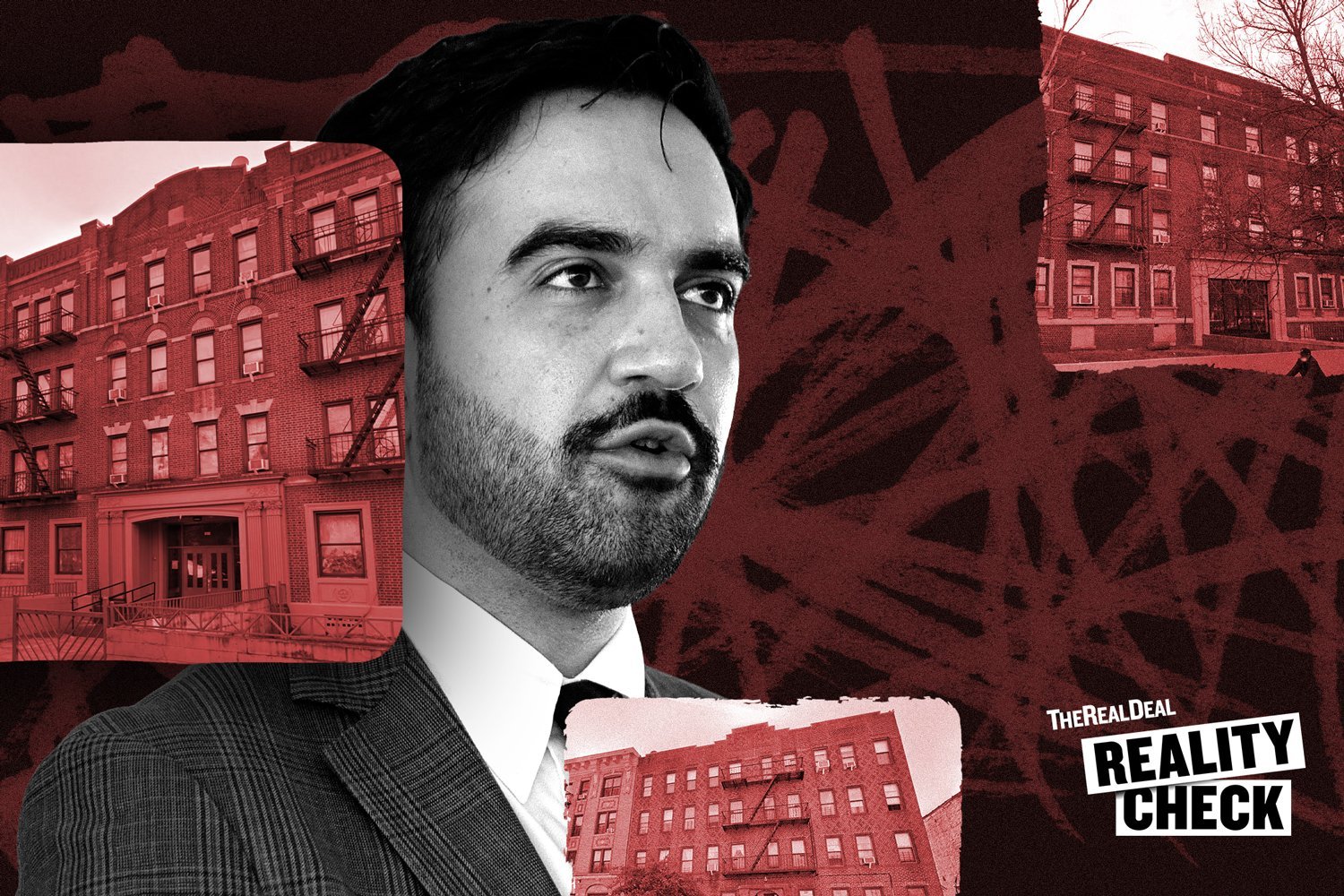
When Mayor Zohran Mamdani on Thursday introduced the “switch” of a rent-stabilized portfolio, I assumed: Have the socialist property seizures begun?
In a single sense, sure, as a result of the mayor is dangling metropolis assets to steer buildings affected by frozen rents to a purchaser he likes. And since he likes the client, he’s cheering the $86,000-per-unit sale simply months after slamming an $88,000-per-unit sale as too expensive.
Mamdani’s press launch wrapped up the transaction in a neat little bow.
“Right now, Mayor Zohran Kwame Mamdani celebrated the switch of three long-neglected, rent-stabilized residence buildings in Crown Heights, Brooklyn, placing 88 houses on a path towards higher stability, funding and improved situations,” it declared.
The buildings — 1018 and 1074 Japanese Parkway and 1392 Sterling Place — have been “beforehand owned by Rubin Dukler, who routinely ranked amongst New York Metropolis’s worst landlords,” the discharge added.
Seems Dukler has been useless for 4 and a half years, and this was a foreclosures sale with an advanced backstory, as my colleague Lilah Burke reported. The back-back-story is the devaluation of rent-stabilized buildings, socialists’ seizure dream and Mamdani’s plan for distressed properties.
It begins in late 2017 when Chayim “CK” Kirschenbaum’s Iris Holdings Group agreed to purchase the portfolio from the Dukler household. The precise proprietor was Rikud Realty, an obvious portmanteau of Dukler and Sarah Richter, whose title I discovered on a 1973 mortgage.
Kirschenbaum backed out when a lead-poisoning case saddled Rikud with a $2.2 million judgment. Then one thing else additional devalued the properties: the 2019 Housing Stability and Tenant Safety Act.
If not for that legislation, Kirschenbaum would seemingly have labored one thing out with the Duklers and glued up the properties utilizing Particular person House Enhancements and Main Capital Enhancements. However after the HSTPA strangled these applications and ended the 20 p.c hire enhance upon emptiness, he would have been loopy to pay the 2017 contracted worth.
Decade of neglect
Kirschenbaum had toured 1392 Sterling and appeared desirous to get to work, a tenant chief on the constructing told Curbed. However the legislation quickly prevented house owners from recovering the price of important enhancements to rent-stabilized buildings. So the deal didn’t shut, and the Dukler portfolio languished.
For the tenants, a full decade of struggling adopted. They endured roaches, mice, rats, leaks, mould and frigid situations, amongst different issues.
Town put the buildings into its Alternative Enforcement Program and made some emergency repairs, however AEP isn’t very effective, as Mamdani’s personal housing staff has acknowledged. Tenants’ distress persevered.
However not less than their rents stayed low. That’s the premise of the HSTPA: crappiness as an reasonably priced housing coverage.
Mamdani’s plan to rescue such buildings is to switch them to “accountable stewards,” however there is no such thing as a dependable mechanism to do this. Town’s days of seizing buildings for unpaid taxes and water payments are lengthy gone, changed by a lien sale and a program referred to as Third Party Transfer. Each have been repeatedly suspended by town pending reforms that never seem to happen.
A second downside is math. If a constructing’s working bills depart no cash for upkeep and renovations, it doesn’t matter if the constructing is transferred to a “accountable steward” or to the tenants themselves. Somebody has to pay for the housing.
Thus, Mamdani can not confiscate properties as hard-core socialists need. He has to placate them by taking part in up distressed gross sales as “transfers.”
Nonetheless, town does have applications in its toolbox to facilitate offers that it favors. One known as Article XI.
It’s nearly impossible for conventional rent-stabilized buildings to get this discretionary property tax break from town. However it may erase most of a portfolio’s property taxes, decreasing them from 30 p.c of hire income to single digits, liberating up cash for enhancements, salaries and revenue. (Press releases by no means point out salaries and revenue, however they’re mandatory for folks to purchase and restore buildings.)
Kirschenbaum tried to get Article XI to make the Dukler portfolio viable, however failed. Most Article XI functions do. Perhaps he’s not one of many metropolis’s most popular landlords. So he discovered somebody who’s: Mark Schwartz.
Intelligent deal
Kirschenbaum nonetheless wanted to wrest the three buildings from the Duklers, whose patriarch had died in February 2022. So he labored somewhat actual property magic.
One among his agency’s buyers purchased the $2.2 million lead-poisoning judgment (in all probability for a fraction of that quantity), used it for a credit score bid to purchase the portfolio in a foreclosures sale, and instantly flipped the buildings to Schwartz for $7.6 million, together with all their liabilities.
That’s $86,000 per unit, about the identical worth that Mamdani mentioned was an excessive amount of for Summit USA to pay for the Pinnacle portfolio, which had far fewer violations per unit.
It’s a putting distinction. Mamdani went to courtroom to dam an $88,000-per-unit sale, arguing that it wouldn’t depart sufficient cash to repair and preserve the buildings. Now he’s celebrating an $86,000-per-unit sale of buildings in even worse situation, and signaling that he’ll grant Schwartz a property tax break and a low-interest metropolis mortgage to make it doable.
Schwartz occurs to be the mayor of Teaneck, New Jersey. Being a mayor makes you a accountable steward, apparently.
One other winner will probably be whichever nonprofit receives charges to run the Housing Growth Fund Company set as much as be the nominal proprietor of the portfolio. Search for the City Homesteading Help Board to get that gig.
An HDFC, together with a 40-year regulatory settlement with set-asides for the homeless, is required to get Article XI. However Schwartz’s agency, Brooklyn Inexpensive Housing Associates, would stay the useful proprietor.
Confused? Don’t fear. Legal professionals and consultants will probably be paid six figures to set all this up.
“Shifting towards possession”
Mamdani’s launch made the whole lot sound easy: “The tenant union has reached an settlement with Schwartz that commits to rehabilitating the three buildings with tenant oversight and transferring towards resident possession.”
It’s not clear what “transferring towards resident possession” means. You both personal a constructing otherwise you don’t.
Would possession even make sense for these renters? Usually, rent-stabilized tenants haven’t any capability or purpose to personal their buildings. It will imply the tip of their minimal rent increases, assured lease renewals and succession rights. As an alternative of calling 311, they must repair issues themselves.
Alternatively, self-management makes much more sense than dwelling in squalor or trudging by way of housing courtroom and metropolis forms each time you need to patch a mouse gap or nail down a unfastened flooring board.
As house owners, the residents of 1018 and 1074 Japanese Parkway and 1392 Sterling Place must pay the complete price of their housing. Even with a property tax break, that may find yourself being much more than they bargained for.
However that’s a narrative for one more day.
Learn extra
How New York kneecapped rehabs

Bistricer snags massive tax break for crumbling Flatbush Gardens

The Daily Dirt: A tax exemption for rent-stabilized portfolios hasn’t been so helpful
