

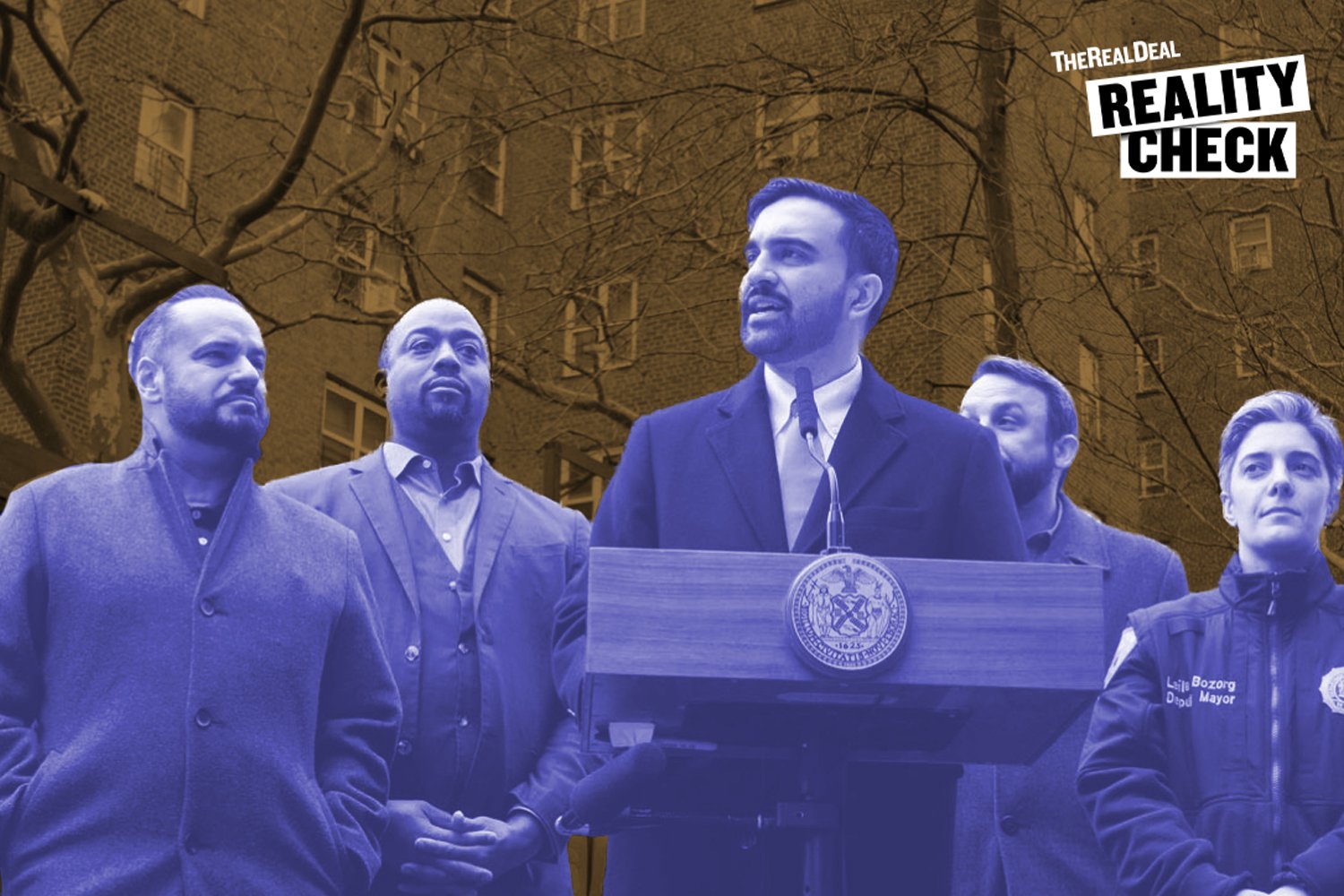
The very first thing I seen about Mayor Zohran Mamdani’s housing plan, which he cleverly launched whereas I used to be on trip, was its $22 billion price ticket.
That was down from $100 billion throughout his mayoral marketing campaign. But its purpose remained 200,000 new reasonably priced housing models, and he’d added the preservation of 200,000.
Even $100 billion was an unrealistically low value for 200,000 union-built, reasonably priced properties — solely $500,000 apiece. Clearly the town can’t construct or protect twice as many for $78 billion much less.
I got down to make sense of Mamdani’s math.
A technique he made the value tag appear smaller was by utilizing a five-year spending whole (the $22 billion “dedication”) for a 10-year plan.
However the greatest change from his marketing campaign plan was a pivot to actuality.
Overlook borrowing $70 billion via bonds and tapping Gary LaBarbera’s boys to construct 200,000 social housing models.
As a substitute, Mamdani will unleash the non-public sector to finance and develop reasonably priced residences, backed not by taxpayers however by a good higher variety of market-rate models.
The mainstream media neglected this momentous shift. The New York Instances identified that Mamdani “appeared to backtrack from a marketing campaign promise to make use of union labor on reasonably priced housing tasks,” however it omitted that the plan depends on for-profit rental developments, that are about 70 % market-rate, to fulfill his targets.
It additionally leans closely on metropolis and state reforms achieved in the course of the Adams administration. Mamdani, to his credit score, goals to use these modifications whereas doing extra upzoning of his personal.
His plan cheers one headwind as if it have been a profit: the town’s Construction Justice Act, which might mandate building wages and advantages price $40 an hour on “focused city-assisted housing tasks.” The invoice was handed in December, earlier than Mamdani took workplace.
Mamdani’s embrace of that legislation was a little bit of advantage signaling, as a result of he has no alternative however to abide by it.
Thankfully for him, that wage flooring doesn’t apply to 485x projects of fewer than 100 models, nor to office conversions. These non-public tasks should carry the freight for the town to achieve Mamdani’s magic quantity.
Winners and losers
The 112-page housing plan is powerful on including new properties and weak on coping with previous ones. That’s, it’s good for builders and dangerous for rent-stabilized landlords.
Mamdani and his deputy mayor for housing, Leila Bozorg, clearly understood that the foundation of the town’s affordability drawback is its housing scarcity, and that the poor, working class, center class and even increased earners endure from it.
Their housing plan additionally acknowledged the significance of buyers and personal builders in fixing it, though it made that time implicitly to keep away from antagonizing New Yorkers who blame business greed for top rents.
Mamdani’s plan places one other nail within the coffin of the pernicious fable that any improvement apart from social housing raises rents and causes displacement.
Solely paleozoic politicians like Meeting member Jo Ann Simon nonetheless perpetuate that notion, particularly with the socialist star Mamdani solidly within the YIMBY camp. His plan even specifies that gentrification is attributable to lack of improvement:
“Many years of underbuilding have produced one of the vital extreme housing shortages within the metropolis’s historical past,” it says. “With fewer residences out there, new models that do come available on the market hire for about $3,000 per thirty days… This shortage drives gentrification, displacement, segregation, and homelessness.”
Builders may need most popular to see that increased up than web page 64, however needs to be grateful that it appeared in any respect.
To execute his supply-side technique, Mamdani goals to assault the scarcity from each angle, together with:
- Rezoning, particularly in high-opportunity, transit-rich, low-growth areas just like the Higher East Aspect, West Village and Park Slope. Because of pre-Mamdani Metropolis Constitution revisions, subsequent yr the mayor-controlled Metropolis Planning Fee will be capable to rezone unilaterally within the least productive 12 of the town’s 59 group districts. Non-public builders and metropolis planners might be scouring these areas for websites.
- Pursuing extra tasks just like the Adams administration’s workplace conversions of 100 Gold Street (by GFP Actual Property) and 395 Flatbush (by Rabina and Park Tower Group). The latter will yield practically 1,300 models, 350 of them deeply reasonably priced, with no subsidy apart from the as-of-right 485x.
- Partnering with nonprofit and MWBE corporations to redevelop smaller, city-owned websites utilizing a predevelopment course of that takes months, not years. Faculties, libraries, clinics and different public services can be modernized as they add housing.
- Permitting new neighborhoods on massive, publicly managed websites just like the Brooklyn Marine Terminal (already within the works however being blocked by Simon), a hospital campus on Roosevelt Island and Sunnyside Yard in Queens. Redeveloping the 180-acre rail yard, nonetheless, is not feasible with out a huge federal grant.
- Allowing mixed-income improvement on public housing campuses. The primary such mission, initiated two mayors in the past, has been stalled by litigation. Mamdani can also be persevering with his predecessors’ use of for-profit corporations to renovate and handle public housing.
- Pushing the Landmarks Preservation Fee to facilitate air-rights transfers and foster housing creation in historic districts. The latter in all probability received’t quantity to a lot, given the fee’s mindset and Mamdani’s aversion to bullying his companies. Landmarks already authorised two new historic districts on his watch, completely miserable improvement there.
One software not talked about within the doc is the Board of Requirements and Appeals, whose stingy chair was simply changed by a pro-development Mamdani appointee, John Mangin.
The board, which has a new fast track for reasonably priced housing, grants variances via a a lot sooner and cheaper course of than rezoning through the Metropolis Council.
The mayor plans to pursue numerous different new-supply initiatives. Almost all have been tried earlier than, corresponding to legalization of basements as residences.
One new concept is modular accent dwelling models, that are constructed elsewhere, delivered by truck and put in in a day. Town can even present financing and technical help to individuals who need ADUs.
The housing plan includes a slew of affordability efforts. It seeks to enhance and increase packages corresponding to HomeFix and add a Mortgage Help Program, amongst others. It reiterates Mamdani’s pledge to finish property tax inequities, however doesn’t elaborate.
Shortcomings
Beneath the layers of pro-development insurance policies is an underlying fact: The mayor isn’t searching for to create as a lot housing as attainable. Like most progressives in elected workplace, he favors affordability and union-backed wage mandates that restrict the dimensions of some tasks and make others unviable.
These provisions, nonetheless, do endow improvement with political and labor help, that are additionally important for many massive tasks in New York. It’s a tough stability that’s unattainable to good, and Mamdani is hardly the primary mayor to defer to building unions.
Ultimately, the wage flooring set by the state’s 485x and the town’s Building Justice Act might be rendered moot by inflation. However within the intervening years, numerous tasks might be underbuilt or unbuilt.
Grime and punishment
For all of the promise Mamdani’s housing plan presents to builders, it delivers lumps of coal to house owners of deteriorating, rent-stabilized buildings.
It proposes no answer for the tens of 1000’s of vacant rent-stabilized units whose rents, below state legislation, can’t be raised sufficient to justify renovating.
Mamdani is crafting assist plans for distressed reasonably priced housing, however not a lot for rent-stabilized buildings affected by the identical drawback — bills outstripping hire assortment.
The discrepancy is definitely defined. Inexpensive housing tends to be owned by nonprofits and underwritten by the town. Lease-stabilized buildings will not be. They’re on the mistaken aspect of a political divide.
Mamdani’s plan pledges to focus on “landlords who speculate on buildings, persistently disregard repairs, and refuse to enhance or change their enterprise practices.”
It’s unclear how his administration will distinguish them from house owners who’re merely being crushed by state and metropolis legal guidelines and eviction-averse housing courts.
Salt of their wounds is pending: a Mamdani-backed bill would steer gross sales of distressed buildings to nonprofits. The mayor, in truth, intends to speed up and intervene in that course of.
Town will launch investigations this yr of a minimum of 10 portfolios “with the biggest focus of long-standing, egregious violations…to make sure that these buildings are transferred out of those dangerous actors’ arms and conveyed to accountable preservation purchasers who’re supported by each tenants and the administration.”
The technique, as landlord-side legal professional Sherwin Belkin sees it, is to barrage buildings with violations and penalties, classify them as distressed and switch possession to nonprofits and tenant teams.
“This can be a critical menace to the true property business,” Belkin posted on LinkedIn. “Critical minds have to derive options earlier than an excessive amount of injury is finished.”
Learn extra
Landlord does the math on his vacant apartment

Mamdani’s housing plan picks winners and losers

The most talked about part of Mamdani’s housing plan wasn’t in his housing plan
