

A fundamental reality not effectively understood by the general public and politicians is that builders should increase cash for his or her initiatives — and can’t if the anticipated return doesn’t compensate for traders’ danger.
In different phrases: No revenue, no mission.
One elected official who will get it’s Brooklyn Borough President Antonio Reynoso, a congressional candidate and unofficial member of the town’s YIMBY motion.
I used to be impressed to see this sentence in his conditional advice of Monitor Level, a 1,150-unit mission on the Greenpoint waterfront deliberate by the Picket household’s Gotham Group:
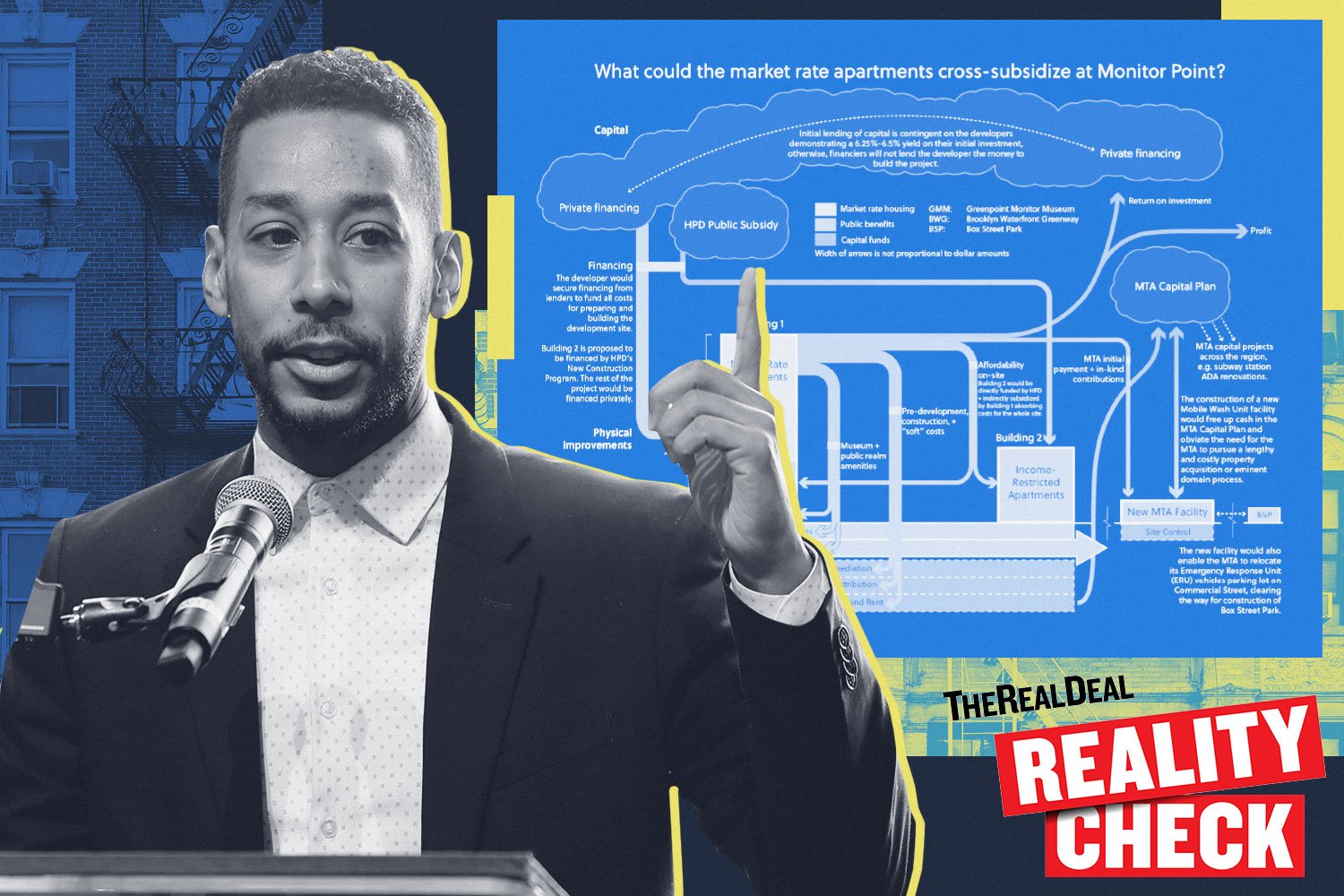
“Preliminary lending of capital is contingent on the builders demonstrating a 6.25 % to six.5 % yield on their preliminary funding; in any other case, financiers won’t lend the developer cash to construct the mission.”
These returns are decrease than I’d anticipate. However the level is, I didn’t anticipate him to incorporate numbers in any respect, even when they have been tucked away on web page 13.
Under that sentence, Reynoso delivered a primer on the funds of housing improvement.
A movement chart confirmed how funding would are available in, what it might construct, how the market-rate models would generate income and all of the locations that income would go.
Many of the income locations are useful: backed residences, a Greenpoint Monitor Museum, public realm facilities, park upkeep, a brand new MTA bus-washing facility and floor hire for transit funding.
Extra arrows present returns going to traders and revenue going, effectively, into the ether (however presumably to Gotham, run by David Picket).
Reynoso’s diagram additionally depicts “Constructing 2” getting financing from the Division of Housing Preservation and Improvement and cash from the market-rate tenants’ hire funds.
Cash flows into Constructing 2, however not out. It’s a graphic illustration that low-income housing prices slightly than produces cash, although tenants pay hire.
Reynoso additionally lays out a dynamic that the native Council member, Lincoln Restler, omitted from his argument that half of the models have to be inexpensive as a result of the mission makes use of public land.
“The MTA website is basically completely different from different publicly owned websites in that the bottom has not been transferred to the developer at a zero or nominal price,” Reynoso notes. “Moderately, the applicant is required to expend upfront and ongoing prices that must be offset by the market-rate models.”
In spite of everything that, nevertheless, Reynoso makes the identical demand as Restler: that half of the models be inexpensive — a regular not often, if ever, reached in such initiatives. Nonetheless, the borough president needs a few of these income-restricted models to be for moderate-income households (incomes 90 % to 120 % of the realm median revenue).
That is likely to be how Restler plans to get Gotham to conform to 50 % affordability, as a result of middle-class tenants pay far more hire than these at 60 % of AMI.
Gotham could also be fascinated by higher-AMI models as effectively, as a result of its preliminary proposal was for 40 % affordability — unusually excessive, due to that low-interest HPD financing. Now Gotham must do higher so Restler can take credit score for one thing.
Rezonings sometimes require a deal that permits the native Council member to spotlight a negotiated public profit. Having some greater AMI ranges additionally works higher socially. It creates extra range amongst tenants.
The Metropolis Council is scheduled to vote on the mission’s rezoning late subsequent month. Ought to it reject the appliance, Gotham may attraction to a brand new three-member panel that features Reynoso.
If all that fails, Gotham may construct a smaller mission as-of-right. Its settlement with the Metropolitan Transportation Authority doesn’t let the developer off the hook if the rezoning is blocked. Gotham would nonetheless must construct the MTA a bus-washing facility and pay $29 million (as an alternative of $61 million) in floor hire, amongst different issues.
The opposite companies that responded to the RFP additionally submitted as-of-right options, however in 2021 the MTA discovered Gotham’s Plan B to be probably the most beneficiant. I noticed it as a wager by Gotham that Plan B received’t be wanted as a result of Plan A shall be accepted. We’ll discover out quickly sufficient.
Learn extra
Gotham Org’s Bushwick project pits liberal pol against Mamdani

Day in the Life of: David Picket

Lincoln Restler’s vacancy proposal is a red flag for real estate
